

Everyone knows the Tate Modern, but do they know the building used to be a power station? Its transformation into a world renowned art gallery began in 1995, gutting the building and reconstructing the inside. The Tate Modern opened to the public in May 2000.
One of the most memorable parts of the building for me is the Turbine Hall, the huge space you walk into when you first enter. It is five storeys/35 metres high and 152 metres long. It has been used for displaying large commissioned art works, some of which I have found images for, above.
The very top image is by Olafur Eliasson, 2003-04. It is called The Weather Project, and is meant to represent the sun. It was made with a giant semi-circular form, and mono-frequenct lamps (otherwise known as street-lamps) circling it from behind. A fine mist infiltrated the air, creating an air of mystery and awe.
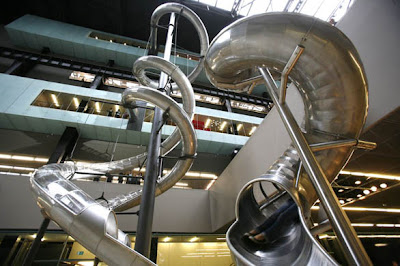
Carsten Holler created Test Site 2006. These were a series of tubes spiralling down from the top floor to the ground floor in the turbine hall. The name implies this is just a trial run for something even larger and better.
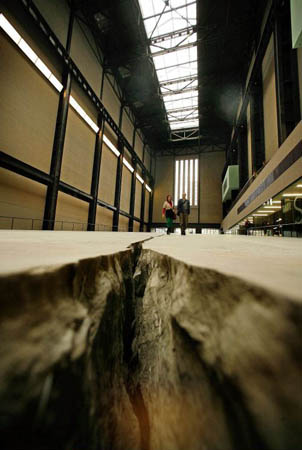
In 2007 Shibboleth by Doris Salcedo was commissioned. She created a chasm down the whole length of the turbine hall. Shibboleth means a custom, behaviour etc, that distinguishes different social classes. The fissure in the floor to me signifies how underneath our modern ways lies deeper issues that need to be addressed.
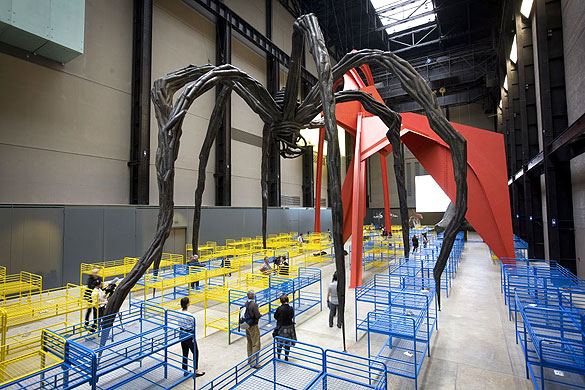
TH.2058 by Dominique Gonzalez-Foerster was installed in 2008. It looked at what life would be like in 50 years time, and feature bunk beds, huge bug like sculptures, and snippets of science fiction films played on a huge screen. One of her biggest influences was the weather, and in particular the never ending rain, and how London has adapted to it. The scene represents a shelter where Londoners can take refuge from the rain, as well as the giant sculptures standing among the beds. The bunk beds are scattered with books, saved from the rain. I went to the Tate Modern when this installation was up, but unfortunately only saw it from above, and didn't have enough time to look around it. The first thing I saw was the giant spider sculpture towering above everything else. I couldn't see much else, I think I must have been on the top floor, but it was striking, and I did get an idea that it was something sci-fi related.
Embankment by Rachel Whiteread featured 14,000 casts of the inside of boxes, stacked on top of each other. The box that gave her inspiration was in her mothers house, shortly after she had died. It held memories for her, and from there she found more boxes to create the mountains of box casts. I vaguely remember visiting the Tate Modern when this installation was in the hall, and thinking they looke like sugar cubes. Whiteread wanted to make the hall look like a warehouse, and I think she succeeded.
This year Miroslaw Balka is being commissioned for the tenth installation in the Unilever series. It opens on 13th October if you are interested in visiting, and finishes 5th April 2010.



 I got quite excited about seeing this painting by Picasso, mostly because I wrote an essay on Cubism and analysed it for quite a while. It is called La Demoiselles d'Avignon and it was the very first Cubist painting, revolutionising art there on after. It depicts five prostitutes in a brothel. Picasso was influenced by Primitivism and African tribal masks, which Picasso said was to warn off evil spirits. It was unlike anything that had ever been painted before, women were usually rounded with soft edges, not sharp and pointy. Many people didn't like it because went completely against traditional painting, but some did, including Georges Braque, whose work was heavily influenced by Cubism. I was surprised it wasn't bigger than it was, I imagined it to be a huge painting but it was quite modest. Overall it was a highlight of the MOMA.
 There was a lot of Andy Warhol, including the soup cans and this Marilyn Monroe print. Golden Marilyn Monroe was painted right after Monroe died, and it has a religious feel about it, due to the golden background and the lone print or Marilyn's head.
 This painting by Edward Ruscha made me smile. Oof is a word found in comic books, so its somewhat odd seeing it in big yellow letters on a big canvas. The colours make it striking and its difficult not to notice it. Ruscha said they hold "a certain comedic value" which I definitely agree with, and it makes this strange painting even more appealing.


 I got to visit the Guggenheim in New York the other week. It's not like any other building I've seen. Amongst the grandeur of the Upper East Side it looks other worldly, it has a futuristic air about it, even though it was completed in 1959. Frank Lloyd Wright was the brains behind the building, and he was known for his innovative architecture. Unfortunately for him and Solomon R. Guggenheim, who founded the Guggenheim foundation, neither lived to see the building completed.